A few nice what is a purchasing agent images I found:
Feel My Pulse (1928) … FSU News – New app helps the dating scene — for girls (1:31 AM, Jan. 17, 2013 ) …item 3.. “Surrogates” – Official Trailer [HQ] — FEEL WHAT THEY FEEL …
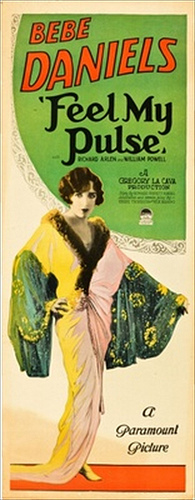
Image by marsmet531
Either way, the app has become wildly popular at other universities and has just been released at FSU. I got a chance to Skype with Lulu’s bubbly CEO Alexandra Chong, who gave me some insight as to what the app is really about, how girls can use it to their advantage, and how guys can improve their chances of scoring favorably among the ladies.
.
……..*****All images are copyrighted by their respective authors ……..
.
………………………………………………………………………………………………………………………………………………………………………….
.
…..item 1)…. FSU News … www.fsunews.com … New app helps the dating scene — for girls
Lulu lets girls rate guys anonymously and honestly
1:31 AM, Jan. 17, 2013 |
.
……………………..
img code photo … Lulu CEO Alexandra Chong
cmsimg.tallahassee.com/apps/pbcsi.dll/bilde?Site=CD&D…
Lulu CEO Alexandra Chong / Photo courtest of Lulu
……………………..
.
Written by
Zachary Goldstein
Content Specialist @creativenole
FILED UNDER
FSU News
www.fsunews.com/article/20130117/FSVIEW/130116030/New-app…|newswell|text|frontpage|p
Girls talking to girls talking to guys—there’s an app for that. And that app is taking the dating world by storm—for girls at least.
Lulu is the first social networking app that has one simple yet strict requirement for membership: girls only. In essence, it allows girls to rate guys based on certain dating criteria, such as attractiveness and future aspirations. It also allows girls to create reviews of guys that can be, according to the app’s iTunes description, “brutally honest without worrying that it will end up on someone’s Facebook wall or in your crush’s hands.” Whew. Maybe it’s the proverbial payback for the no-girls-allowed boy’s club in the backyard treehouse.
Either way, the app has become wildly popular at other universities and has just been released at FSU. I got a chance to Skype with Lulu’s bubbly CEO Alexandra Chong, who gave me some insight as to what the app is really about, how girls can use it to their advantage, and how guys can improve their chances of scoring favorably among the ladies.
FSView & Florida Flambeau: Thanks for taking the time to talk with us today.
Alexandra Chong: You’re welcome, thanks for having me.
FFF: So, how long has Lulu been a thing?
AC: We launched a product last year in London under the name of Luluvise. It was a product that had the social communication aspects of a female-only social network. Lulu is a derivative of that original launch—it’s the most sought-after feature of Luluvise that was originally called WikiDate. We launched it as an app under the name Lulu.
FFF: It’s very unorthodox in its approach to social connectivity—girls only, guys can’t see their ratings. Where did the idea actually come from?
AC: So, it kind of came from my experiences with my girlfriends. We would get together and chat about our love lives, and we would talk about a date we had been on or a review a guy. It was basically the same thing that the app does, but in person or on the phone. The idea was “okay, let’s incorporate that into the app,” and that feature evolved from there.
FFF: Was there a pivotal moment where you thought “Hey, girls need something like this. Society needs something like this.”? Was there a ‘lightbulb moment’?
AC: Yeah, there definitely was. It was valentines day a few years ago in London. I was sitting at a valentines day lunch and there were about thirty other girls who didn’t know each other, and I can only imagine the conversations that started. That was actually the moment—and I remember being a bit tipsy from many glasses of champagne and I called my girlfriend in New York and we began talking about the idea. She’s now the co-founder, Alison Schwartz, and Lulu was born.
FFF: Not to stereotype, but what kind of girls is this app built for? What are the end results—is it a ‘dating app’ or a ‘social app’ or a ‘hook-up app’?
AC: We are starting to see through usage more and more what it is going to turn into. Originally we wanted it to be something fun, not mean or hurtful, or to ruin other people’s reputations—we wanted to allow girls to tap into other girls’ pools of knowledge and for it to become a dating resource. That’s what the creation of Lulu was for, and that’s how it seems to be being used.
FFF: You mentioned creating a space that isn’t hurtful. I know a lot of guys that may feel intimidated by an app like this. I know a few that just shrug it off, but I know some others who take it pretty seriously. What do you think?
AC: We were surprised to see the reactions from guys—they all said “We want to get in.” For every two girls we accept into Lulu, we turn away one guy who is trying to break in—either by creating a fake female account on Facebook or something like that. There’s something there that [the typical guy] really wants to see. Typically, the reaction that we see is that more guys are concerned that they are not on Lulu and not being talked about.
FFF: That’s interesting.
AC: Yeah. The reaction that we are hearing from guys is, “how do I get myself onto Lulu?” That’s the reason that we decided to create LuluDude, which we just launched, which allows guys to essentially claim their profiles and manage their reputations based in indications of what girls are saying about them.
FFF: We’ll talk more about LuluDude in a moment. Let’s go back to idea that more guys are concerned about not being on Lulu than being on Lulu. I know some guys who have been in relationships for several years, way before Lulu was created, who when they broke it off with their girlfriends have been torn apart on Lulu. I know it’s case-by-case, but is there anything stopping one single user from disproportionately affecting a guy’s profile?
AC: I think we have built a structured platform, so the results are not at all biased. We have a feature that allows girls to agree and disagree with particular ratings. We also give girls the option to disagree and create their own review on the gentleman—and of course, LuluDude allows the guy to get an indicator of how they’re doing and certainly to request other girls who they know will give them favorable reviews to up their scores.
FFF: So, LuluDude. From what I understand, it gives guys the chance to bolster their profiles on Lulu. Is that right?
AC: It allows them to put their best face forward. It lets them manage their profile, change their profile picture, add information about themselves in the form of hashtags, tell us what turns them on, tell us what turns them off. Essentially, it lets them talk to their fan base. In Lulu, girls can ‘star’ guys, which basically starts their fan clubs. What we hope is that on LuluDude, guys will eventually be able to communicate with their fan bases. In the future we hope to be able to add a feature that would tell his fan base where he is going to be later that night, for example.
FFF: Speaking of the future, here’s a million-dollar question that a lot of people have expressed interest in: is there any plan in the future for you to release an app that would let guys rate girls?
AC: [Laughs] Haha, there are no immediate plans to let guys review girls.
FFF: The app seems like it could do a lot for the way girls date. That said, with the world of technology moving so fast, how do you plan on keeping the app from being lost among the noise, or being considered ‘trendy’?
AC: We’ve just released this pilot app at FSU now—it’s been live for a few weeks now. We’ve got thousands of girls on the app at the moment, and I think yesterday I saw that there were close to 50,000 reviews on guys. So there are lots of really early positive signs for being live for just a month. It’s still early to say what is really going to happen, but we plan on rolling out to another 20 plus schools over the rest of January and we have agents on campuses to help that initiative.
FFF: Lulu gets lots of points for being original in the dating world. Any plans to create any other apps on the back or front burner?
AC: As of now, Lulu and LuluDude are the core products that we are going to focus on. Lulu was built for girls, and guys were really an afterthought as we saw how much interest they were showing. We certainly have a lot of features and more enhanced capabilities for girls to discover guys on Lulu and, at one point, connect with them.
FFF: To end things on a light note, if you were stuck on a desert island with one movie, one cocktail, and access to one website that’s not Google, what would they be?
AC: Definitely a Moscow Mule, since its my favorite drink. Can’t be Google—I’ll say Facebook. And one movie? The Sound of Music. Definitely one of my favorites.
FFF: Awesome. Thanks so much for your time.
AC: Thanks for talking with me.
.
.
…………………………………………………………………………………………………………………………………………………………………….
.
…..item 2)…. youtube video … Youtube Mix … Tom Petty – Runnin’ down a Dream – Lyrics …
4:21 minutes …
1992Nicky1992
www.youtube.com/watch?v=FiJg0A3RrTk&playnext=1&li…
Uploaded on Jan 23, 2010
Other Song from Guitar Hero 5: Tom Petty – Runnin’ down a Dream with Lyrics. Have fun.
Category
Music
License
Standard YouTube License
.
.
……………………………………………………………………………………………………………………………………………………………………..
.
…..item 3)…. youtube video … "Surrogates" – Official Trailer [HQ] … 2:32 minutes …
www.youtube.com/watch?v=UGwQ74cH5O0
watchCulturetainment
Uploaded on Jun 9, 2009
Starring Bruce Willis, Radha Mitchell, Rosamund Pike, James Francis Ginty, Boris Kodjoe and Ving Rhames
FBI agents (BRUCE WILLIS and RADHA MITCHELL) investigate the mysterious murder of a college student linked to the man who helped create a high-tech surrogate phenomenon that allows people to purchase unflawed robotic versions of themselves – fit, good looking remotely controlled machines that ultimately assume their life roles – enabling people to experience life vicariously from the comfort and safety of their own homes. The murder spawns a quest for answers: in a world of masks, whos real and who can you trust?
Category
Film & Animation
License
Standard YouTube License
.
.
……………………………………………………………………………………………………………………………………………………………………..
.
.
Banksy in Boston: F̶O̶L̶L̶O̶W̶ ̶Y̶O̶U̶R̶ ̶D̶R̶E̶A̶M̶S̶ CANCELLED, Essex St, Chinatown, Boston
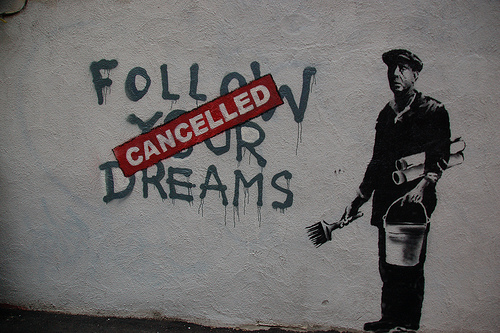
Image by Chris Devers
Interestingly, both of the Boston area Banksy pieces are on Essex St:
• F̶O̶L̶L̶O̶W̶ ̶Y̶O̶U̶R̶ ̶D̶R̶E̶A̶M̶S̶ CANCELLED (aka chimney sweep) in Chinatown, Boston
• NO LOITRIN in Central Square, Cambridge.
Does that mean anything? It looks like he favors Essex named streets & roads when he can. In 2008, he did another notable Essex work in London, for example, and posters on the Banksy Forums picked up & discussed on the Essex link as well.
Is there an Essex Street in any of the other nearby towns? It looks like there are several: Brookline, Charlestown, Chelsea, Gloucester, Haverhill, Lawrence, Lynn, Medford, Melrose, Quincy, Revere, Salem, Saugus, Somerville, Swampscott, and Waltham. Most of these seem improbable to me, other than maybe Brookline, or maybe Somerville or Charlestown. But they start getting pretty suburban after that.
But, again, why "Essex"? In a comment on this photo, Birbeck helps clarify:
I can only surmise that he’s having a ‘dig’ at Essex UK, especially with the misspelling of ‘Loitering’. Here, the general view of the urban districts in Essex: working class but with right wing views; that they’re not the most intellectual bunch; rather obsessed with fashion (well, their idea of it); their place of worship is the shopping mall; enjoy rowdy nights out; girls are thought of as being dumb, fake blonde hair/tans and promiscuous; and guys are good at the ‘chit chat’, and swagger around showing off their dosh (money).
It was also the region that once had Europe’s largest Ford motor factory. In its heyday, 1 in 3 British cars were made in Dagenham, Essex. Pay was good for such unskilled labour, generations worked mind-numbing routines on assembly lines for 80 years. In 2002 the recession ended the dream.
• • • • •
• Meredith Goldsten of the Boston Globe wrote to me on Facebook and asked for permission to run one of my Banksy photos in the newspaper, which I granted. Supposedly, this photo or one of the others I took appeared in the Globe on 15 May 2010, but I haven’t been able to find it. The online version of that day’s article, titled Tag — we’re it: Banksy, the controversial and elusive street artist, left his mark here. Or did he? uses a photo taken by "Essdras M. Suarez / Globe Staff". If I can find a copy of that day’s paper and verify that one of my Banksy photos was in there, I’ll scan the page & post a copy here 🙂
• This photo appeared on Grafitti – A arte das ruas on Yahoo Meme. Yes, Yahoo has a Tumblr/Posterous-esque "Meme" service now — I was as surprised as you are.
• This photo also appeared on Love Your Chaos on Tumblr, among other blogs. Thanks!
• • • • •
Banksy
From Wikipedia, the free encyclopedia
Banksy
• Birth name
Unknown
• Born
1974 or 1975 (1974 or 1975), Bristol, UK[1]
• Nationality
British
• Field
Graffiti
Street Art
Bristol underground scene
Sculpture
• Movement
Anti-Totalitarianism
Anti-capitalism
Pacifism
Anti-War
Anarchism
Atheism
Anti-Fascism
• Works
Naked Man Image
One Nation Under CCTV
Anarchist Rat
Ozone’s Angel
Pulp Fiction
Banksy is a pseudonymous[2][3][4] British graffiti artist. He is believed to be a native of Yate, South Gloucestershire, near Bristol[2] and to have been born in 1974,[5] but his identity is unknown.[6] According to Tristan Manco[who?], Banksy "was born in 1974 and raised in Bristol, England. The son of a photocopier technician, he trained as a butcher but became involved in graffiti during the great Bristol aerosol boom of the late 1980s."[7] His artworks are often satirical pieces of art on topics such as politics, culture, and ethics. His street art, which combines graffiti writing with a distinctive stencilling technique, is similar to Blek le Rat, who began to work with stencils in 1981 in Paris and members of the anarcho-punk band Crass who maintained a graffiti stencil campaign on the London Tube System in the late 1970s and early 1980s. His art has appeared in cities around the world.[8] Banksy’s work was born out of the Bristol underground scene which involved collaborations between artists and musicians.
Banksy does not sell photos of street graffiti.[9] Art auctioneers have been known to attempt to sell his street art on location and leave the problem of its removal in the hands of the winning bidder.[10]
Banksy’s first film, Exit Through The Gift Shop, billed as "the world’s first street art disaster movie", made its debut at the 2010 Sundance Film Festival.[11] The film was released in the UK on March 5.[12]
Contents
• 1 Career
•• 1.1 2000
•• 1.2 2002
•• 1.3 2003
•• 1.4 2004
•• 1.5 2005
•• 1.6 2006
•• 1.7 2007
•• 1.8 2008
•• 1.9 2009
•• 1.10 2010
• 2 Notable art pieces
• 3 Technique
• 4 Identity
• 5 Controversy
• 6 Bibliography
• 7 References
• 8 External links
Career
Banksy started as a freehand graffiti artist 1992–1994[14] as one of Bristol’s DryBreadZ Crew (DBZ), with Kato and Tes.[15] He was inspired by local artists and his work was part of the larger Bristol underground scene. From the start he used stencils as elements of his freehand pieces, too.[14] By 2000 he had turned to the art of stencilling after realising how much less time it took to complete a piece. He claims he changed to stencilling whilst he was hiding from the police under a train carriage, when he noticed the stencilled serial number[16] and by employing this technique, he soon became more widely noticed for his art around Bristol and London.[16]
Stencil on the waterline of The Thekla, an entertainment boat in central Bristol – (wider view). The image of Death is based on a 19th century etching illustrating the pestilence of The Great Stink.[17]
Banksy’s stencils feature striking and humorous images occasionally combined with slogans. The message is usually anti-war, anti-capitalist or anti-establishment. Subjects often include rats, monkeys, policemen, soldiers, children, and the elderly.
In late 2001, on a trip to Sydney and Melbourne, Australia, he met up with the Gen-X pastellist, visual activist, and recluse James DeWeaver in Byron Bay[clarification needed], where he stencilled a parachuting rat with a clothes peg on its nose above a toilet at the Arts Factory Lodge. This stencil can no longer be located. He also makes stickers (the Neighbourhood Watch subvert) and sculpture (the murdered phone-box), and was responsible for the cover art of Blur’s 2003 album Think Tank.
2000
The album cover for Monk & Canatella‘s Do Community Service was conceived and illustrated by Banksy, based on his contribution to the "Walls on fire" event in Bristol 1998.[18][citation needed]
2002
On 19 July 2002, Banksy’s first Los Angeles exhibition debuted at 33 1/3 Gallery, a small Silverlake venue owned by Frank Sosa. The exhibition, entitled Existencilism, was curated by 33 1/3 Gallery, Malathion, Funk Lazy Promotions, and B+.[19]
2003
In 2003 in an exhibition called Turf War, held in a warehouse, Banksy painted on animals. Although the RSPCA declared the conditions suitable, an animal rights activist chained herself to the railings in protest.[20] He later moved on to producing subverted paintings; one example is Monet‘s Water Lily Pond, adapted to include urban detritus such as litter and a shopping trolley floating in its reflective waters; another is Edward Hopper‘s Nighthawks, redrawn to show that the characters are looking at a British football hooligan, dressed only in his Union Flag underpants, who has just thrown an object through the glass window of the cafe. These oil paintings were shown at a twelve-day exhibition in Westbourne Grove, London in 2005.[21]
2004
In August 2004, Banksy produced a quantity of spoof British £10 notes substituting the picture of the Queen’s head with Princess Diana‘s head and changing the text "Bank of England" to "Banksy of England." Someone threw a large wad of these into a crowd at Notting Hill Carnival that year, which some recipients then tried to spend in local shops. These notes were also given with invitations to a Santa’s Ghetto exhibition by Pictures on Walls. The individual notes have since been selling on eBay for about £200 each. A wad of the notes were also thrown over a fence and into the crowd near the NME signing tent at The Reading Festival. A limited run of 50 signed posters containing ten uncut notes were also produced and sold by Pictures on Walls for £100 each to commemorate the death of Princess Diana. One of these sold in October 2007 at Bonhams auction house in London for £24,000.
2005
In August 2005, Banksy, on a trip to the Palestinian territories, created nine images on Israel’s highly controversial West Bank barrier. He reportedly said "The Israeli government is building a wall surrounding the occupied Palestinian territories. It stands three times the height of the Berlin Wall and will eventually run for over 700km—the distance from London to Zurich. "[22]
2006
• Banksy held an exhibition called Barely Legal, billed as a "three day vandalised warehouse extravaganza" in Los Angeles, on the weekend of 16 September. The exhibition featured a live "elephant in a room", painted in a pink and gold floral wallpaper pattern.[23]
• After Christina Aguilera bought an original of Queen Victoria as a lesbian and two prints for £25,000,[24] on 19 October 2006 a set of Kate Moss paintings sold in Sotheby’s London for £50,400, setting an auction record for Banksy’s work. The six silk-screen prints, featuring the model painted in the style of Andy Warhol‘s Marilyn Monroe pictures, sold for five times their estimated value. His stencil of a green Mona Lisa with real paint dripping from her eyes sold for £57,600 at the same auction.[25]
• In December, journalist Max Foster coined the phrase, "the Banksy Effect", to illustrate how interest in other street artists was growing on the back of Banksy’s success.[26]
2007
• On 21 February 2007, Sotheby’s auction house in London auctioned three works, reaching the highest ever price for a Banksy work at auction: over £102,000 for his Bombing Middle England. Two of his other graffiti works, Balloon Girl and Bomb Hugger, sold for £37,200 and £31,200 respectively, which were well above their estimated prices.[27] The following day’s auction saw a further three Banksy works reach soaring prices: Ballerina With Action Man Parts reached £96,000; Glory sold for £72,000; Untitled (2004) sold for £33,600; all significantly above estimated values.[28] To coincide with the second day of auctions, Banksy updated his website with a new image of an auction house scene showing people bidding on a picture that said, "I Can’t Believe You Morons Actually Buy This Shit."[6]
• In February 2007, the owners of a house with a Banksy mural on the side in Bristol decided to sell the house through Red Propeller art gallery after offers fell through because the prospective buyers wanted to remove the mural. It is listed as a mural which comes with a house attached.[29]
• In April 2007, Transport for London painted over Banksy’s iconic image of a scene from Quentin Tarantino‘s Pulp Fiction, with Samuel L. Jackson and John Travolta clutching bananas instead of guns. Although the image was very popular, Transport for London claimed that the "graffiti" created "a general atmosphere of neglect and social decay which in turn encourages crime" and their staff are "professional cleaners not professional art critics".[30] Banksy tagged the same site again (pictured at right). This time the actors were portrayed as holding real guns instead of bananas, but they were adorned with banana costumes. Banksy made a tribute art piece over this second Pulp Fiction piece. The tribute was for 19-year-old British graffiti artist Ozone, who was hit by an underground train in Barking, East London, along with fellow artist Wants, on 12 January 2007.[31] The piece was of an angel wearing a bullet-proof vest, holding a skull. He also wrote a note on his website, saying:
The last time I hit this spot I painted a crap picture of two men in banana costumes waving hand guns. A few weeks later a writer called Ozone completely dogged it and then wrote ‘If it’s better next time I’ll leave it’ in the bottom corner. When we lost Ozone we lost a fearless graffiti writer and as it turns out a pretty perceptive art critic. Ozone – rest in peace.[citation needed]
Ozone’s Angel
• On 27 April 2007, a new record high for the sale of Banksy’s work was set with the auction of the work Space Girl & Bird fetching £288,000 (US6,000), around 20 times the estimate at Bonhams of London.[32]
• On 21 May 2007 Banksy gained the award for Art’s Greatest living Briton. Banksy, as expected, did not turn up to collect his award, and continued with his notoriously anonymous status.
• On 4 June 2007, it was reported that Banksy’s The Drinker had been stolen.[33][34]
• In October 2007, most of his works offered for sale at Bonhams auction house in London sold for more than twice their reserve price.[35]
• Banksy has published a "manifesto" on his website.[36] The text of the manifesto is credited as the diary entry of one Lieutenant Colonel Mervin Willett Gonin, DSO, which is exhibited in the Imperial War Museum. It describes how a shipment of lipstick to the Bergen-Belsen concentration camp immediately after its liberation at the end of World War II helped the internees regain their humanity. However, as of 18 January 2008, Banksy’s Manifesto has been substituted with Graffiti Heroes #03 that describes Peter Chappell’s graffiti quest of the 1970s that worked to free George Davis of his imprisonment.[37] By 12 August 2009 he was relying on Emo Phillips’ "When I was a kid I used to pray every night for a new bicycle. Then I realised God doesn’t work that way, so I stole one and prayed for forgiveness."
• A small number of Banksy’s works can be seen in the movie Children of Men, including a stenciled image of two policemen kissing and another stencil of a child looking down a shop.
• In the 2007 film Shoot ‘Em Up starring Clive Owen, Banksy’s tag can be seen on a dumpster in the film’s credits.
• Banksy, who deals mostly with Lazarides Gallery in London, claims that the exhibition at Vanina Holasek Gallery in New York (his first major exhibition in that city) is unauthorised. The exhibition featured 62 of his paintings and prints.[38]
2008
• In March, a stencilled graffiti work appeared on Thames Water tower in the middle of the Holland Park roundabout, and it was widely attributed to Banksy. It was of a child painting the tag "Take this Society" in bright orange. London Borough of Hammersmith and Fulham spokesman, Councillor Greg Smith branded the art as vandalism, and ordered its immediate removal, which was carried out by H&F council workmen within three days.[39]
• Over the weekend 3–5 May in London, Banksy hosted an exhibition called The Cans Festival. It was situated on Leake Street, a road tunnel formerly used by Eurostar underneath London Waterloo station. Graffiti artists with stencils were invited to join in and paint their own artwork, as long as it didn’t cover anyone else’s.[40] Artists included Blek le Rat, Broken Crow, C215, Cartrain, Dolk, Dotmasters, J.Glover, Eine, Eelus, Hero, Pure evil, Jef Aérosol, Mr Brainwash, Tom Civil and Roadsworth.[citation needed]
• In late August 2008, marking the third anniversary of Hurricane Katrina and the associated levee failure disaster, Banksy produced a series of works in New Orleans, Louisiana, mostly on buildings derelict since the disaster.[41]
• A stencil painting attributed to Banksy appeared at a vacant petrol station in the Ensley neighbourhood of Birmingham, Alabama on 29 August as Hurricane Gustav approached the New Orleans area. The painting depicting a hooded member of the Ku Klux Klan hanging from a noose was quickly covered with black spray paint and later removed altogether.[42]
• His first official exhibition in New York, the "Village Pet Store And Charcoal Grill," opened 5 October 2008. The animatronic pets in the store window include a mother hen watching over her baby Chicken McNuggets as they peck at a barbecue sauce packet, and a rabbit putting makeup on in a mirror.[43]
• The Westminster City Council stated in October 2008 that the work "One Nation Under CCTV", painted in April 2008 will be painted over as it is graffiti. The council says it will remove any graffiti, regardless of the reputation of its creator, and specifically stated that Banksy "has no more right to paint graffiti than a child". Robert Davis, the chairman of the council planning committee told The Times newspaper: "If we condone this then we might as well say that any kid with a spray can is producing art". [44] The work was painted over in April 2009.
• In December 2008, The Little Diver, a Banksy image of a diver in a duffle coat in Melbourne Australia was vandalised. The image was protected by a sheet of clear perspex, however silver paint was poured behind the protective sheet and later tagged with the words "Banksy woz ere". The image was almost completely destroyed.[45].
2009
• May 2009, parts company with agent Steve Lazarides. Announces Pest Control [46] the handling service who act on his behalf will be the only point of sale for new works.
• On 13 June 2009, the Banksy UK Summer show opened at Bristol City Museum and Art Gallery, featuring more than 100 works of art, including animatronics and installations; it is his largest exhibition yet, featuring 78 new works.[47][48] Reaction to the show was positive, with over 8,500 visitors to the show on the first weekend.[49] Over the course of the twelve weeks, the exhibition has been visited over 300,000 times.[50]
• In September 2009, a Banksy work parodying the Royal Family was partially destroyed by Hackney Council after they served an enforcement notice for graffiti removal to the former address of the property owner. The mural had been commissioned for the 2003 Blur single "Crazy Beat" and the property owner, who had allowed the piece to be painted, was reported to have been in tears when she saw it was being painted over.[51]
• In December 2009, Banksy marked the end of the 2009 United Nations Climate Change Conference by painting four murals on global warming. One included "I don’t believe in global warming" which was submerged in water.[52]
2010
• The world premiere of the film Exit Through the Gift Shop occurred at the Sundance Film Festival in Park City, Utah, on 24 January. He created 10 street pieces around Park City and Salt Lake City to tie in with the screening.[53]
• In February, The Whitehouse public house in Liverpool, England, is sold for £114,000 at auction.[54] The side of the building has an image of a giant rat by Banksy.[55]
• In April 2010, Melbourne City Council in Australia reported that they had inadvertently ordered private contractors to paint over the last remaining Banksy art in the city. The image was of a rat descending in a parachute adorning the wall of an old council building behind the Forum Theatre. In 2008 Vandals had poured paint over a stencil of an old-fashioned diver wearing a trenchcoat. A council spokeswoman has said they would now rush through retrospective permits to protect other “famous or significant artworks” in the city.[56]
• In April 2010 to coincide with the premier of Exit through the Gift Shop in San Francisco, 5 of his pieces appeared in various parts of the city.[57] Banksy reportedly paid a Chinatown building owner for the use of their wall for one of his stencils.[58]
• In May 2010 to coincide with the release of "Exit Through the Gift Shop" in Chicago, one piece appeared in the city.
Notable art pieces
In addition to his artwork, Banksy has claimed responsibility for a number of high profile art pieces, including the following:
• At London Zoo, he climbed into the penguin enclosure and painted "We’re bored of fish" in seven foot high letters.[59]
• At Bristol Zoo, he left the message ‘I want out. This place is too cold. Keeper smells. Boring, boring, boring.’ in the elephant enclosure.[60]
• In March 2005, he placed subverted artworks in the Museum of Modern Art, Metropolitan Museum of Art, the Brooklyn Museum, and the American Museum of Natural History in New York.[61]
• He put up a subverted painting in London’s Tate Britain gallery.
• In May 2005 Banksy’s version of a primitive cave painting depicting a human figure hunting wildlife whilst pushing a shopping trolley was hung in gallery 49 of the British Museum, London. Upon discovery, they added it to their permanent collection.[62]
Near Bethlehem – 2005
• Banksy has sprayed "This is not a photo opportunity" on certain photograph spots.
• In August 2005, Banksy painted nine images on the Israeli West Bank barrier, including an image of a ladder going up and over the wall and an image of children digging a hole through the wall.[22][63][64][65]
See also: Other Banksy works on the Israeli West Bank barrier
• In April 2006, Banksy created a sculpture based on a crumpled red phone box with a pickaxe in its side, apparently bleeding, and placed it in a street in Soho, London. It was later removed by Westminster Council. BT released a press release, which said: "This is a stunning visual comment on BT’s transformation from an old-fashioned telecommunications company into a modern communications services provider."[66]
• In June 2006, Banksy created an image of a naked man hanging out of a bedroom window on a wall visible from Park Street in central Bristol. The image sparked some controversy, with the Bristol City Council leaving it up to the public to decide whether it should stay or go.[67] After an internet discussion in which 97% (all but 6 people) supported the stencil, the city council decided it would be left on the building.[67] The mural was later defaced with paint.[67]
• In August/September 2006, Banksy replaced up to 500 copies of Paris Hilton‘s debut CD, Paris, in 48 different UK record stores with his own cover art and remixes by Danger Mouse. Music tracks were given titles such as "Why am I Famous?", "What Have I Done?" and "What Am I For?". Several copies of the CD were purchased by the public before stores were able to remove them, some going on to be sold for as much as £750 on online auction websites such as eBay. The cover art depicted Paris Hilton digitally altered to appear topless. Other pictures feature her with a dog’s head replacing her own, and one of her stepping out of a luxury car, edited to include a group of homeless people, which included the caption "90% of success is just showing up".[68][69][70]
• In September 2006, Banksy dressed an inflatable doll in the manner of a Guantanamo Bay detainment camp prisoner (orange jumpsuit, black hood, and handcuffs) and then placed the figure within the Big Thunder Mountain Railroad ride at the Disneyland theme park in Anaheim, California.[71][72]
Technique
Asked about his technique, Banksy said:
“I use whatever it takes. Sometimes that just means drawing a moustache on a girl’s face on some billboard, sometimes that means sweating for days over an intricate drawing. Efficiency is the key.[73]”
Stencils are traditionally hand drawn or printed onto sheets of acetate or card, before being cut out by hand. Because of the secretive nature of Banksy’s work and identity, it is uncertain what techniques he uses to generate the images in his stencils, though it is assumed he uses computers for some images due to the photocopy nature of much of his work.
He mentions in his book, Wall and Piece, that as he was starting to do graffiti, he was always too slow and was either caught or could never finish the art in the one sitting. So he devised a series of intricate stencils to minimise time and overlapping of the colour.
Identity
Banksy’s real name has been widely reported to be Robert or Robin Banks.[74][75][76] His year of birth has been given as 1974.[62]
Simon Hattenstone from Guardian Unlimited is one of the very few people to have interviewed him face-to-face. Hattenstone describes him as "a cross of Jimmy Nail and British rapper Mike Skinner" and "a 28 year old male who showed up wearing jeans and a t-shirt with a silver tooth, silver chain, and one silver earring".[77] In the same interview, Banksy revealed that his parents think their son is a painter and decorator.[77]
In May 2007, an extensive article written by Lauren Collins of the New Yorker re-opened the Banksy-identity controversy citing a 2004 photograph of the artist that was taken in Jamaica during the Two-Culture Clash project and later published in the Evening Standard in 2004.[6]
In October 2007, a story on the BBC website featured a photo allegedly taken by a passer-by in Bethnal Green, London, purporting to show Banksy at work with an assistant, scaffolding and a truck. The story confirms that Tower Hamlets Council in London has decided to treat all Banksy works as vandalism and remove them.[78]
In July 2008, it was claimed by The Mail on Sunday that Banksy’s real name is Robin Gunningham.[3][79] His agent has refused to confirm or deny these reports.
In May 2009, the Mail on Sunday once again speculated about Gunningham being Banksy after a "self-portrait" of a rat holding a sign with the word "Gunningham" shot on it was photographed in East London.[80] This "new Banksy rat" story was also picked up by The Times[81] and the Evening Standard.
Banksy, himself, states on his website:
“I am unable to comment on who may or may not be Banksy, but anyone described as being ‘good at drawing’ doesn’t sound like Banksy to me.[82]”
Controversy
In 2004, Banksy walked into the Louvre in Paris and hung on a wall a picture he had painted resembling the Mona Lisa but with a yellow smiley face. Though the painting was hurriedly removed by the museum staff, it and its counterpart, temporarily on unknown display at the Tate Britain, were described by Banksy as "shortcuts". He is quoted as saying:
“To actually [have to] go through the process of having a painting selected must be quite boring. It’s a lot more fun to go and put your own one up.[83]”
Peter Gibson, a spokesperson for Keep Britain Tidy, asserts that Banksy’s work is simple vandalism,[84] and Diane Shakespeare, an official for the same organization, was quoted as saying: "We are concerned that Banksy’s street art glorifies what is essentially vandalism".[6]
In June 2007 Banksy created a circle of plastic portable toilets, said to resemble Stonehenge at the Glastonbury Festival. As this was in the same field as the "sacred circle" it was felt by many to be inappropriate and his installation was itself vandalized before the festival even opened. However, the intention had always been for people to climb on and interact with it.[citation needed] The installation was nicknamed "Portaloo Sunset" and "Bog Henge" by Festival goers. Michael Eavis admitted he wasn’t fond of it, and the portaloos were removed before the 2008 festival.
In 2010, an artistic feud developed between Banksy and his rival King Robbo after Banksy painted over a 24-year old Robbo piece on the banks of London’s Regent Canal. In retaliation several Banksy pieces in London have been painted over by ‘Team Robbo’.[85][86]
Also in 2010, government workers accidentally painted over a Banksy art piece, a famed "parachuting-rat" stencil, in Australia’s Melbourne CBD. [87]
Bibliography
Banksy has self-published several books that contain photographs of his work in various countries as well as some of his canvas work and exhibitions, accompanied by his own writings:
• Banksy, Banging Your Head Against A Brick Wall (2001) ISBN 978-0-95417040-0
• Banksy, Existencilism (2002) ISBN 978-0-95417041-7
• Banksy, Cut it Out (2004) ISBN 978-0-95449600-5
• Banksy, Wall and Piece (2005) ISBN 978-1-84413786-2
• Banksy, Pictures of Walls (2005) ISBN 978-0-95519460-3
Random House published Wall and Piece in 2005. It contains a combination of images from his three previous books, as well as some new material.[16]
Two books authored by others on his work were published in 2006 & 2007:
• Martin Bull, Banksy Locations and Tours: A Collection of Graffiti Locations and Photographs in London (2006 – with new editions in 2007 and 2008) ISBN 978-0-95547120-9.
• Steve Wright, Banksy’s Bristol: Home Sweet Home (2007) ISBN 978-1906477004
External links
• Official website
• Banksy street work photos
Banksy in Boston: View of F̶O̶L̶L̶O̶W̶ ̶Y̶O̶U̶R̶ ̶D̶R̶E̶A̶M̶S̶ CANCELLED on Essex St, Chinatown, Boston, with rush hour traffic
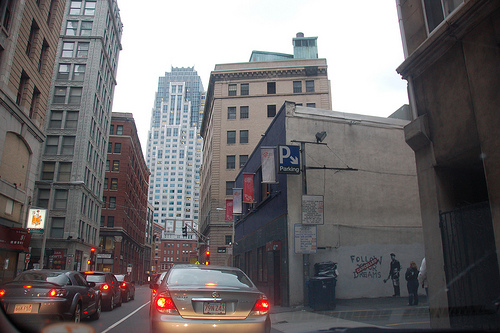
Image by Chris Devers
Interestingly, both of the Boston area Banksy pieces are on Essex St:
• F̶O̶L̶L̶O̶W̶ ̶Y̶O̶U̶R̶ ̶D̶R̶E̶A̶M̶S̶ CANCELLED (aka chimney sweep) in Chinatown, Boston
• NO LOITRIN in Central Square, Cambridge.
Does that mean anything? It looks like he favors Essex named streets & roads when he can. In 2008, he did another notable Essex work in London, for example, and posters on the Banksy Forums picked up & discussed on the Essex link as well.
Is there an Essex Street in any of the other nearby towns? It looks like there are several: Brookline, Charlestown, Chelsea, Gloucester, Haverhill, Lawrence, Lynn, Medford, Melrose, Quincy, Revere, Salem, Saugus, Somerville, Swampscott, and Waltham. Most of these seem improbable to me, other than maybe Brookline, or maybe Somerville or Charlestown. But they start getting pretty suburban after that.
But, again, why "Essex"? In a comment on this photo, Birbeck helps clarify:
I can only surmise that he’s having a ‘dig’ at Essex UK, especially with the misspelling of ‘Loitering’. Here, the general view of the urban districts in Essex: working class but with right wing views; that they’re not the most intellectual bunch; rather obsessed with fashion (well, their idea of it); their place of worship is the shopping mall; enjoy rowdy nights out; girls are thought of as being dumb, fake blonde hair/tans and promiscuous; and guys are good at the ‘chit chat’, and swagger around showing off their dosh (money).
It was also the region that once had Europe’s largest Ford motor factory. In its heyday, 1 in 3 British cars were made in Dagenham, Essex. Pay was good for such unskilled labour, generations worked mind-numbing routines on assembly lines for 80 years. In 2002 the recession ended the dream.
• • • • •
This photo appeared on Grafitti – A arte das ruas on Yahoo Meme. Yes, Yahoo has a Tumblr/Posterous-esque "Meme" service now — I was as surprised as you are.
• • • • •
Banksy
From Wikipedia, the free encyclopedia
Banksy
• Birth name
Unknown
• Born
1974 or 1975 (1974 or 1975), Bristol, UK[1]
• Nationality
British
• Field
Graffiti
Street Art
Bristol underground scene
Sculpture
• Movement
Anti-Totalitarianism
Anti-capitalism
Pacifism
Anti-War
Anarchism
Atheism
Anti-Fascism
• Works
Naked Man Image
One Nation Under CCTV
Anarchist Rat
Ozone’s Angel
Pulp Fiction
Banksy is a pseudonymous[2][3][4] British graffiti artist. He is believed to be a native of Yate, South Gloucestershire, near Bristol[2] and to have been born in 1974,[5] but his identity is unknown.[6] According to Tristan Manco[who?], Banksy "was born in 1974 and raised in Bristol, England. The son of a photocopier technician, he trained as a butcher but became involved in graffiti during the great Bristol aerosol boom of the late 1980s."[7] His artworks are often satirical pieces of art on topics such as politics, culture, and ethics. His street art, which combines graffiti writing with a distinctive stencilling technique, is similar to Blek le Rat, who began to work with stencils in 1981 in Paris and members of the anarcho-punk band Crass who maintained a graffiti stencil campaign on the London Tube System in the late 1970s and early 1980s. His art has appeared in cities around the world.[8] Banksy’s work was born out of the Bristol underground scene which involved collaborations between artists and musicians.
Banksy does not sell photos of street graffiti.[9] Art auctioneers have been known to attempt to sell his street art on location and leave the problem of its removal in the hands of the winning bidder.[10]
Banksy’s first film, Exit Through The Gift Shop, billed as "the world’s first street art disaster movie", made its debut at the 2010 Sundance Film Festival.[11] The film was released in the UK on March 5.[12]
Contents
• 1 Career
•• 1.1 2000
•• 1.2 2002
•• 1.3 2003
•• 1.4 2004
•• 1.5 2005
•• 1.6 2006
•• 1.7 2007
•• 1.8 2008
•• 1.9 2009
•• 1.10 2010
• 2 Notable art pieces
• 3 Technique
• 4 Identity
• 5 Controversy
• 6 Bibliography
• 7 References
• 8 External links
Career
Banksy started as a freehand graffiti artist 1992–1994[14] as one of Bristol’s DryBreadZ Crew (DBZ), with Kato and Tes.[15] He was inspired by local artists and his work was part of the larger Bristol underground scene. From the start he used stencils as elements of his freehand pieces, too.[14] By 2000 he had turned to the art of stencilling after realising how much less time it took to complete a piece. He claims he changed to stencilling whilst he was hiding from the police under a train carriage, when he noticed the stencilled serial number[16] and by employing this technique, he soon became more widely noticed for his art around Bristol and London.[16]
Stencil on the waterline of The Thekla, an entertainment boat in central Bristol – (wider view). The image of Death is based on a 19th century etching illustrating the pestilence of The Great Stink.[17]
Banksy’s stencils feature striking and humorous images occasionally combined with slogans. The message is usually anti-war, anti-capitalist or anti-establishment. Subjects often include rats, monkeys, policemen, soldiers, children, and the elderly.
In late 2001, on a trip to Sydney and Melbourne, Australia, he met up with the Gen-X pastellist, visual activist, and recluse James DeWeaver in Byron Bay[clarification needed], where he stencilled a parachuting rat with a clothes peg on its nose above a toilet at the Arts Factory Lodge. This stencil can no longer be located. He also makes stickers (the Neighbourhood Watch subvert) and sculpture (the murdered phone-box), and was responsible for the cover art of Blur’s 2003 album Think Tank.
2000
The album cover for Monk & Canatella‘s Do Community Service was conceived and illustrated by Banksy, based on his contribution to the "Walls on fire" event in Bristol 1998.[18][citation needed]
2002
On 19 July 2002, Banksy’s first Los Angeles exhibition debuted at 33 1/3 Gallery, a small Silverlake venue owned by Frank Sosa. The exhibition, entitled Existencilism, was curated by 33 1/3 Gallery, Malathion, Funk Lazy Promotions, and B+.[19]
2003
In 2003 in an exhibition called Turf War, held in a warehouse, Banksy painted on animals. Although the RSPCA declared the conditions suitable, an animal rights activist chained herself to the railings in protest.[20] He later moved on to producing subverted paintings; one example is Monet‘s Water Lily Pond, adapted to include urban detritus such as litter and a shopping trolley floating in its reflective waters; another is Edward Hopper‘s Nighthawks, redrawn to show that the characters are looking at a British football hooligan, dressed only in his Union Flag underpants, who has just thrown an object through the glass window of the cafe. These oil paintings were shown at a twelve-day exhibition in Westbourne Grove, London in 2005.[21]
2004
In August 2004, Banksy produced a quantity of spoof British £10 notes substituting the picture of the Queen’s head with Princess Diana‘s head and changing the text "Bank of England" to "Banksy of England." Someone threw a large wad of these into a crowd at Notting Hill Carnival that year, which some recipients then tried to spend in local shops. These notes were also given with invitations to a Santa’s Ghetto exhibition by Pictures on Walls. The individual notes have since been selling on eBay for about £200 each. A wad of the notes were also thrown over a fence and into the crowd near the NME signing tent at The Reading Festival. A limited run of 50 signed posters containing ten uncut notes were also produced and sold by Pictures on Walls for £100 each to commemorate the death of Princess Diana. One of these sold in October 2007 at Bonhams auction house in London for £24,000.
2005
In August 2005, Banksy, on a trip to the Palestinian territories, created nine images on Israel’s highly controversial West Bank barrier. He reportedly said "The Israeli government is building a wall surrounding the occupied Palestinian territories. It stands three times the height of the Berlin Wall and will eventually run for over 700km—the distance from London to Zurich. "[22]
2006
• Banksy held an exhibition called Barely Legal, billed as a "three day vandalised warehouse extravaganza" in Los Angeles, on the weekend of 16 September. The exhibition featured a live "elephant in a room", painted in a pink and gold floral wallpaper pattern.[23]
• After Christina Aguilera bought an original of Queen Victoria as a lesbian and two prints for £25,000,[24] on 19 October 2006 a set of Kate Moss paintings sold in Sotheby’s London for £50,400, setting an auction record for Banksy’s work. The six silk-screen prints, featuring the model painted in the style of Andy Warhol‘s Marilyn Monroe pictures, sold for five times their estimated value. His stencil of a green Mona Lisa with real paint dripping from her eyes sold for £57,600 at the same auction.[25]
• In December, journalist Max Foster coined the phrase, "the Banksy Effect", to illustrate how interest in other street artists was growing on the back of Banksy’s success.[26]
2007
• On 21 February 2007, Sotheby’s auction house in London auctioned three works, reaching the highest ever price for a Banksy work at auction: over £102,000 for his Bombing Middle England. Two of his other graffiti works, Balloon Girl and Bomb Hugger, sold for £37,200 and £31,200 respectively, which were well above their estimated prices.[27] The following day’s auction saw a further three Banksy works reach soaring prices: Ballerina With Action Man Parts reached £96,000; Glory sold for £72,000; Untitled (2004) sold for £33,600; all significantly above estimated values.[28] To coincide with the second day of auctions, Banksy updated his website with a new image of an auction house scene showing people bidding on a picture that said, "I Can’t Believe You Morons Actually Buy This Shit."[6]
• In February 2007, the owners of a house with a Banksy mural on the side in Bristol decided to sell the house through Red Propeller art gallery after offers fell through because the prospective buyers wanted to remove the mural. It is listed as a mural which comes with a house attached.[29]
• In April 2007, Transport for London painted over Banksy’s iconic image of a scene from Quentin Tarantino‘s Pulp Fiction, with Samuel L. Jackson and John Travolta clutching bananas instead of guns. Although the image was very popular, Transport for London claimed that the "graffiti" created "a general atmosphere of neglect and social decay which in turn encourages crime" and their staff are "professional cleaners not professional art critics".[30] Banksy tagged the same site again (pictured at right). This time the actors were portrayed as holding real guns instead of bananas, but they were adorned with banana costumes. Banksy made a tribute art piece over this second Pulp Fiction piece. The tribute was for 19-year-old British graffiti artist Ozone, who was hit by an underground train in Barking, East London, along with fellow artist Wants, on 12 January 2007.[31] The piece was of an angel wearing a bullet-proof vest, holding a skull. He also wrote a note on his website, saying:
The last time I hit this spot I painted a crap picture of two men in banana costumes waving hand guns. A few weeks later a writer called Ozone completely dogged it and then wrote ‘If it’s better next time I’ll leave it’ in the bottom corner. When we lost Ozone we lost a fearless graffiti writer and as it turns out a pretty perceptive art critic. Ozone – rest in peace.[citation needed]
Ozone’s Angel
• On 27 April 2007, a new record high for the sale of Banksy’s work was set with the auction of the work Space Girl & Bird fetching £288,000 (US6,000), around 20 times the estimate at Bonhams of London.[32]
• On 21 May 2007 Banksy gained the award for Art’s Greatest living Briton. Banksy, as expected, did not turn up to collect his award, and continued with his notoriously anonymous status.
• On 4 June 2007, it was reported that Banksy’s The Drinker had been stolen.[33][34]
• In October 2007, most of his works offered for sale at Bonhams auction house in London sold for more than twice their reserve price.[35]
• Banksy has published a "manifesto" on his website.[36] The text of the manifesto is credited as the diary entry of one Lieutenant Colonel Mervin Willett Gonin, DSO, which is exhibited in the Imperial War Museum. It describes how a shipment of lipstick to the Bergen-Belsen concentration camp immediately after its liberation at the end of World War II helped the internees regain their humanity. However, as of 18 January 2008, Banksy’s Manifesto has been substituted with Graffiti Heroes #03 that describes Peter Chappell’s graffiti quest of the 1970s that worked to free George Davis of his imprisonment.[37] By 12 August 2009 he was relying on Emo Phillips’ "When I was a kid I used to pray every night for a new bicycle. Then I realised God doesn’t work that way, so I stole one and prayed for forgiveness."
• A small number of Banksy’s works can be seen in the movie Children of Men, including a stenciled image of two policemen kissing and another stencil of a child looking down a shop.
• In the 2007 film Shoot ‘Em Up starring Clive Owen, Banksy’s tag can be seen on a dumpster in the film’s credits.
• Banksy, who deals mostly with Lazarides Gallery in London, claims that the exhibition at Vanina Holasek Gallery in New York (his first major exhibition in that city) is unauthorised. The exhibition featured 62 of his paintings and prints.[38]
2008
• In March, a stencilled graffiti work appeared on Thames Water tower in the middle of the Holland Park roundabout, and it was widely attributed to Banksy. It was of a child painting the tag "Take this Society" in bright orange. London Borough of Hammersmith and Fulham spokesman, Councillor Greg Smith branded the art as vandalism, and ordered its immediate removal, which was carried out by H&F council workmen within three days.[39]
• Over the weekend 3–5 May in London, Banksy hosted an exhibition called The Cans Festival. It was situated on Leake Street, a road tunnel formerly used by Eurostar underneath London Waterloo station. Graffiti artists with stencils were invited to join in and paint their own artwork, as long as it didn’t cover anyone else’s.[40] Artists included Blek le Rat, Broken Crow, C215, Cartrain, Dolk, Dotmasters, J.Glover, Eine, Eelus, Hero, Pure evil, Jef Aérosol, Mr Brainwash, Tom Civil and Roadsworth.[citation needed]
• In late August 2008, marking the third anniversary of Hurricane Katrina and the associated levee failure disaster, Banksy produced a series of works in New Orleans, Louisiana, mostly on buildings derelict since the disaster.[41]
• A stencil painting attributed to Banksy appeared at a vacant petrol station in the Ensley neighbourhood of Birmingham, Alabama on 29 August as Hurricane Gustav approached the New Orleans area. The painting depicting a hooded member of the Ku Klux Klan hanging from a noose was quickly covered with black spray paint and later removed altogether.[42]
• His first official exhibition in New York, the "Village Pet Store And Charcoal Grill," opened 5 October 2008. The animatronic pets in the store window include a mother hen watching over her baby Chicken McNuggets as they peck at a barbecue sauce packet, and a rabbit putting makeup on in a mirror.[43]
• The Westminster City Council stated in October 2008 that the work "One Nation Under CCTV", painted in April 2008 will be painted over as it is graffiti. The council says it will remove any graffiti, regardless of the reputation of its creator, and specifically stated that Banksy "has no more right to paint graffiti than a child". Robert Davis, the chairman of the council planning committee told The Times newspaper: "If we condone this then we might as well say that any kid with a spray can is producing art". [44] The work was painted over in April 2009.
• In December 2008, The Little Diver, a Banksy image of a diver in a duffle coat in Melbourne Australia was vandalised. The image was protected by a sheet of clear perspex, however silver paint was poured behind the protective sheet and later tagged with the words "Banksy woz ere". The image was almost completely destroyed.[45].
2009
• May 2009, parts company with agent Steve Lazarides. Announces Pest Control [46] the handling service who act on his behalf will be the only point of sale for new works.
• On 13 June 2009, the Banksy UK Summer show opened at Bristol City Museum and Art Gallery, featuring more than 100 works of art, including animatronics and installations; it is his largest exhibition yet, featuring 78 new works.[47][48] Reaction to the show was positive, with over 8,500 visitors to the show on the first weekend.[49] Over the course of the twelve weeks, the exhibition has been visited over 300,000 times.[50]
• In September 2009, a Banksy work parodying the Royal Family was partially destroyed by Hackney Council after they served an enforcement notice for graffiti removal to the former address of the property owner. The mural had been commissioned for the 2003 Blur single "Crazy Beat" and the property owner, who had allowed the piece to be painted, was reported to have been in tears when she saw it was being painted over.[51]
• In December 2009, Banksy marked the end of the 2009 United Nations Climate Change Conference by painting four murals on global warming. One included "I don’t believe in global warming" which was submerged in water.[52]
2010
• The world premiere of the film Exit Through the Gift Shop occurred at the Sundance Film Festival in Park City, Utah, on 24 January. He created 10 street pieces around Park City and Salt Lake City to tie in with the screening.[53]
• In February, The Whitehouse public house in Liverpool, England, is sold for £114,000 at auction.[54] The side of the building has an image of a giant rat by Banksy.[55]
• In April 2010, Melbourne City Council in Australia reported that they had inadvertently ordered private contractors to paint over the last remaining Banksy art in the city. The image was of a rat descending in a parachute adorning the wall of an old council building behind the Forum Theatre. In 2008 Vandals had poured paint over a stencil of an old-fashioned diver wearing a trenchcoat. A council spokeswoman has said they would now rush through retrospective permits to protect other “famous or significant artworks” in the city.[56]
• In April 2010 to coincide with the premier of Exit through the Gift Shop in San Francisco, 5 of his pieces appeared in various parts of the city.[57] Banksy reportedly paid a Chinatown building owner for the use of their wall for one of his stencils.[58]
• In May 2010 to coincide with the release of "Exit Through the Gift Shop" in Chicago, one piece appeared in the city.
Notable art pieces
In addition to his artwork, Banksy has claimed responsibility for a number of high profile art pieces, including the following:
• At London Zoo, he climbed into the penguin enclosure and painted "We’re bored of fish" in seven foot high letters.[59]
• At Bristol Zoo, he left the message ‘I want out. This place is too cold. Keeper smells. Boring, boring, boring.’ in the elephant enclosure.[60]
• In March 2005, he placed subverted artworks in the Museum of Modern Art, Metropolitan Museum of Art, the Brooklyn Museum, and the American Museum of Natural History in New York.[61]
• He put up a subverted painting in London’s Tate Britain gallery.
• In May 2005 Banksy’s version of a primitive cave painting depicting a human figure hunting wildlife whilst pushing a shopping trolley was hung in gallery 49 of the British Museum, London. Upon discovery, they added it to their permanent collection.[62]
Near Bethlehem – 2005
• Banksy has sprayed "This is not a photo opportunity" on certain photograph spots.
• In August 2005, Banksy painted nine images on the Israeli West Bank barrier, including an image of a ladder going up and over the wall and an image of children digging a hole through the wall.[22][63][64][65]
See also: Other Banksy works on the Israeli West Bank barrier
• In April 2006, Banksy created a sculpture based on a crumpled red phone box with a pickaxe in its side, apparently bleeding, and placed it in a street in Soho, London. It was later removed by Westminster Council. BT released a press release, which said: "This is a stunning visual comment on BT’s transformation from an old-fashioned telecommunications company into a modern communications services provider."[66]
• In June 2006, Banksy created an image of a naked man hanging out of a bedroom window on a wall visible from Park Street in central Bristol. The image sparked some controversy, with the Bristol City Council leaving it up to the public to decide whether it should stay or go.[67] After an internet discussion in which 97% (all but 6 people) supported the stencil, the city council decided it would be left on the building.[67] The mural was later defaced with paint.[67]
• In August/September 2006, Banksy replaced up to 500 copies of Paris Hilton‘s debut CD, Paris, in 48 different UK record stores with his own cover art and remixes by Danger Mouse. Music tracks were given titles such as "Why am I Famous?", "What Have I Done?" and "What Am I For?". Several copies of the CD were purchased by the public before stores were able to remove them, some going on to be sold for as much as £750 on online auction websites such as eBay. The cover art depicted Paris Hilton digitally altered to appear topless. Other pictures feature her with a dog’s head replacing her own, and one of her stepping out of a luxury car, edited to include a group of homeless people, which included the caption "90% of success is just showing up".[68][69][70]
• In September 2006, Banksy dressed an inflatable doll in the manner of a Guantanamo Bay detainment camp prisoner (orange jumpsuit, black hood, and handcuffs) and then placed the figure within the Big Thunder Mountain Railroad ride at the Disneyland theme park in Anaheim, California.[71][72]
Technique
Asked about his technique, Banksy said:
“I use whatever it takes. Sometimes that just means drawing a moustache on a girl’s face on some billboard, sometimes that means sweating for days over an intricate drawing. Efficiency is the key.[73]”
Stencils are traditionally hand drawn or printed onto sheets of acetate or card, before being cut out by hand. Because of the secretive nature of Banksy’s work and identity, it is uncertain what techniques he uses to generate the images in his stencils, though it is assumed he uses computers for some images due to the photocopy nature of much of his work.
He mentions in his book, Wall and Piece, that as he was starting to do graffiti, he was always too slow and was either caught or could never finish the art in the one sitting. So he devised a series of intricate stencils to minimise time and overlapping of the colour.
Identity
Banksy’s real name has been widely reported to be Robert or Robin Banks.[74][75][76] His year of birth has been given as 1974.[62]
Simon Hattenstone from Guardian Unlimited is one of the very few people to have interviewed him face-to-face. Hattenstone describes him as "a cross of Jimmy Nail and British rapper Mike Skinner" and "a 28 year old male who showed up wearing jeans and a t-shirt with a silver tooth, silver chain, and one silver earring".[77] In the same interview, Banksy revealed that his parents think their son is a painter and decorator.[77]
In May 2007, an extensive article written by Lauren Collins of the New Yorker re-opened the Banksy-identity controversy citing a 2004 photograph of the artist that was taken in Jamaica during the Two-Culture Clash project and later published in the Evening Standard in 2004.[6]
In October 2007, a story on the BBC website featured a photo allegedly taken by a passer-by in Bethnal Green, London, purporting to show Banksy at work with an assistant, scaffolding and a truck. The story confirms that Tower Hamlets Council in London has decided to treat all Banksy works as vandalism and remove them.[78]
In July 2008, it was claimed by The Mail on Sunday that Banksy’s real name is Robin Gunningham.[3][79] His agent has refused to confirm or deny these reports.
In May 2009, the Mail on Sunday once again speculated about Gunningham being Banksy after a "self-portrait" of a rat holding a sign with the word "Gunningham" shot on it was photographed in East London.[80] This "new Banksy rat" story was also picked up by The Times[81] and the Evening Standard.
Banksy, himself, states on his website:
“I am unable to comment on who may or may not be Banksy, but anyone described as being ‘good at drawing’ doesn’t sound like Banksy to me.[82]”
Controversy
In 2004, Banksy walked into the Louvre in Paris and hung on a wall a picture he had painted resembling the Mona Lisa but with a yellow smiley face. Though the painting was hurriedly removed by the museum staff, it and its counterpart, temporarily on unknown display at the Tate Britain, were described by Banksy as "shortcuts". He is quoted as saying:
“To actually [have to] go through the process of having a painting selected must be quite boring. It’s a lot more fun to go and put your own one up.[83]”
Peter Gibson, a spokesperson for Keep Britain Tidy, asserts that Banksy’s work is simple vandalism,[84] and Diane Shakespeare, an official for the same organization, was quoted as saying: "We are concerned that Banksy’s street art glorifies what is essentially vandalism".[6]
In June 2007 Banksy created a circle of plastic portable toilets, said to resemble Stonehenge at the Glastonbury Festival. As this was in the same field as the "sacred circle" it was felt by many to be inappropriate and his installation was itself vandalized before the festival even opened. However, the intention had always been for people to climb on and interact with it.[citation needed] The installation was nicknamed "Portaloo Sunset" and "Bog Henge" by Festival goers. Michael Eavis admitted he wasn’t fond of it, and the portaloos were removed before the 2008 festival.
In 2010, an artistic feud developed between Banksy and his rival King Robbo after Banksy painted over a 24-year old Robbo piece on the banks of London’s Regent Canal. In retaliation several Banksy pieces in London have been painted over by ‘Team Robbo’.[85][86]
Also in 2010, government workers accidentally painted over a Banksy art piece, a famed "parachuting-rat" stencil, in Australia’s Melbourne CBD. [87]
Bibliography
Banksy has self-published several books that contain photographs of his work in various countries as well as some of his canvas work and exhibitions, accompanied by his own writings:
• Banksy, Banging Your Head Against A Brick Wall (2001) ISBN 978-0-95417040-0
• Banksy, Existencilism (2002) ISBN 978-0-95417041-7
• Banksy, Cut it Out (2004) ISBN 978-0-95449600-5
• Banksy, Wall and Piece (2005) ISBN 978-1-84413786-2
• Banksy, Pictures of Walls (2005) ISBN 978-0-95519460-3
Random House published Wall and Piece in 2005. It contains a combination of images from his three previous books, as well as some new material.[16]
Two books authored by others on his work were published in 2006 & 2007:
• Martin Bull, Banksy Locations and Tours: A Collection of Graffiti Locations and Photographs in London (2006 – with new editions in 2007 and 2008) ISBN 978-0-95547120-9.
• Steve Wright, Banksy’s Bristol: Home Sweet Home (2007) ISBN 978-1906477004
External links
• Official website
• Banksy street work photos